


Every machined part is a compromise between what the drawing demands and what the material will tolerate. CNC machining material selection is where that compromise is settled, long before a program is posted. Choose a grade that is too soft and the part wears out; choose one that is too hard and the spindle time, tool wear, and scrap rate all climb together.
Table of Contents
- Start with function, not with a familiar grade
- Nine rules for CNC machining material selection
- Common metals and where they fit
- Engineering plastics worth machining
- Machinability and its real cost
- Dimensional stability after the cut
- Stock forms, availability, and lead time
- Finishing and compliance
- Documentation and traceability
- Frequently asked questions
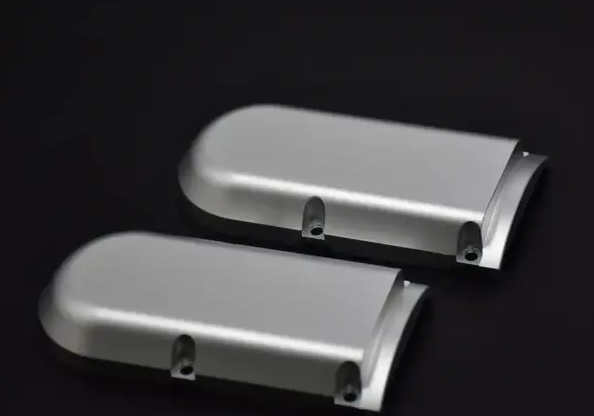
The most expensive mistakes in CNC machining material selection are rarely metallurgical. They are commercial. A grade that machines beautifully but is only stocked in one mill, in one size, with a twelve-week lead time will stall a program that looked completely feasible on paper.
This guide works through the decision in the order a project actually meets it: function, then machinability, then stability, then supply and cost. The rules are the same whether the part is an aluminium bracket, a stainless manifold, or a PEEK insulator.
Start With Function, Not With a Familiar Grade
Most teams begin with a material they have used before, then justify it. That works until the part fails or the cost is challenged. A better sequence is to list what the part must survive: load, temperature, chemical exposure, abrasion, electrical requirement, and appearance. Each of those narrows the candidate list before price is discussed.
A bracket that carries a static load at room temperature has a very wide candidate list. The same bracket inside an engine bay, exposed to road salt and 120 degrees Celsius, has a very short one. Writing those conditions down turns CNC machining material selection from an argument into a filter.
Nine Rules for CNC Machining Material Selection
1. Size the load with a safety factor you can defend
Yield strength is the starting number, but fatigue, stress concentration, and creep decide most failures. For a static part, a factor of two is common; for a cyclic or safety-critical part, the calculation and the test belong in the record.
2. Check the service temperature against the data sheet, derated
Published heat deflection temperatures assume low stress. A plastic that holds its shape at 120 degrees in a catalogue may creep at 90 degrees under a real bolt load. Derate, then verify.
3. Match corrosion resistance to the environment, not the brochure
Type 304 stainless handles most indoor and food environments. Chlorides, marine air, and cleaning chemicals push the choice toward 316 or a duplex grade. Aluminium needs anodising or a coating in wet service.
4. Treat machinability as a cost multiplier
Two grades with the same strength can differ by a factor of three in cutting speed. That difference appears directly in the quote, in tool life, and in the risk of a scrapped part on the last operation.
5. Ask what happens after machining
Residual stress in rolled plate releases when material is removed. A thin wall cut from a stressed blank will move. Stress-relieved stock, symmetric material removal, and a finishing pass are the usual answers.
6. Confirm the stock form before the design freezes
Plate, bar, tube, and near-net forgings each impose a different cost structure. A part designed around a 40 mm bar cannot be cut from 12 mm plate without a redesign of the grain direction and the setup.
7. Avoid specifying a tolerance the material cannot hold
Aluminium moves with temperature; plastics move with humidity. A plus or minus 0.01 mm callout on a 300 mm plastic part is a drawing error, not a machining challenge.
8. Put the finish in the same decision as the material
Anodising, passivation, electropolishing, and bead blasting all depend on the alloy. Some 6000-series aluminiums anodise to a different colour than others from the same specification.
9. Check compliance before the first chip
RoHS, REACH, FDA, UL, and automotive flammability requirements eliminate grades quietly. A material certificate that cannot support the claim is worse than no certificate at all.
Common Metals and Where They Fit
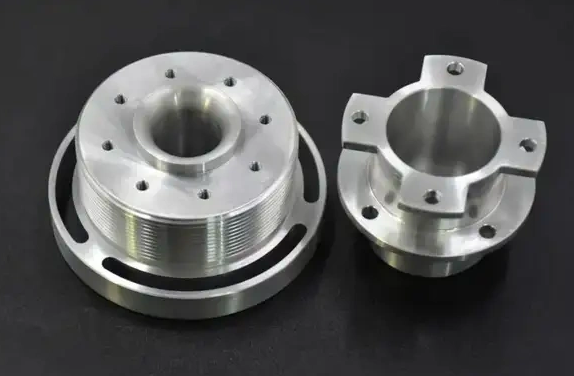
Aluminium 6061 is the default for machined housings, brackets, and fixtures. It cuts fast, welds well, anodises predictably, and is available in almost every thickness. Aluminium 7075 offers roughly twice the strength and machines cleanly, but it is less weldable and costs more per kilogram.
Stainless steel covers a wide range. Grade 303 is the free-machining choice for shafts and fittings, grade 304 for general corrosion resistance, grade 316 for chlorides and medical cleaning, and 17-4 PH when high strength and moderate corrosion resistance are both required. Each step up in corrosion resistance costs cutting speed.
Carbon steel and alloy steel remain the cheapest route for structural parts that will be painted or plated. Brass and copper are chosen for conductivity and for their machinability, which is exceptional. Titanium is specified for weight and corrosion, and it is also the grade most likely to destroy a toolpath written for aluminium.
| Material | Typical use | Machinability | Watch out for |
|---|---|---|---|
| Aluminium 6061 | Housings, brackets, fixtures | Excellent | Low stiffness, thread wear |
| Aluminium 7075 | Aerospace structures, moulds | Very good | Poor weldability, cost |
| Stainless 303 | Shafts, fittings, pins | Good | Lower corrosion resistance |
| Stainless 316L | Medical, marine, chemical | Moderate | Work hardening, tool wear |
| 17-4 PH | High-strength shafts | Moderate | Heat treatment distortion |
| Brass C360 | Connectors, valves | Excellent | Lead content restrictions |
| Titanium Ti-6Al-4V | Aerospace, medical | Poor | Heat, chatter, tool cost |
Engineering Plastics Worth Machining
Plastic parts are machined when the volume is low, the tolerance is tight, or the geometry is not mouldable. POM is the first choice for precision mechanical parts because it is dimensionally stable, machines to a fine finish, and holds a thread. ABS and PC cover housings and covers where impact resistance matters more than stiffness.
PEEK, PEI, and PPS are specified when temperature, chemical resistance, or dielectric performance rules out cheaper grades. They also demand different tooling, sharper edges, and more attention to heat build-up, because a melted edge cannot be polished back into tolerance.
Glass-filled grades complicate CNC machining material selection more than any other family. The fibres are abrasive, so tool life falls, and cutting exposes fibre ends that change the surface chemistry. If the application depends on a sealed or chemically resistant skin, that exposure has to be designed around.
Machinability and Its Real Cost
Machinability is usually expressed as a percentage relative to free-cutting steel, and the number is only a starting point. The practical question is how a grade behaves at the cutting edge: does it form a clean chip, does it work harden, does it conduct heat away from the tool, and does it gall?
Aluminium conducts heat into the part and the fixture, which keeps the tool cool but moves the part as it warms. Stainless steel work hardens if the tool rubs instead of cuts, so a light pass at low feed is the fastest way to ruin a surface. Titanium concentrates heat at the edge, which is why coolant delivery matters more than spindle speed.
For a program with a fixed deadline, the machinability penalty is a schedule risk, not only a cost line. A grade that adds forty percent to cycle time also adds forty percent to the machine hours that must be booked, and those hours may not be available.
Dimensional Stability After the Cut
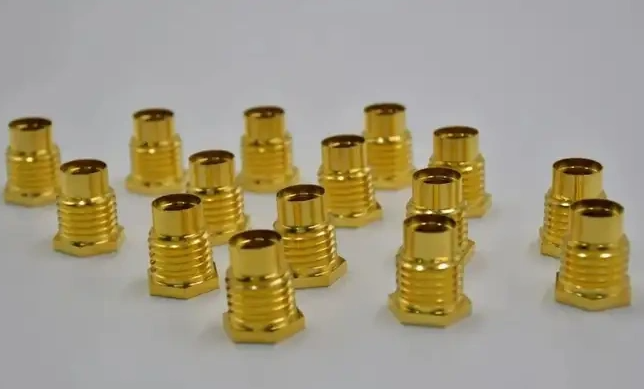
Material removal redistributes internal stress. On a symmetric part the effect is small; on a thin-walled housing or a long slender bracket it can exceed the tolerance. Stress-relieved plate, rough machining followed by a stress-relief pause, and a light finishing cut are the standard countermeasures.
Plastics add two more variables. Moisture absorption swells nylon and PBT, so a part measured dry will not match the same part measured after a week in the factory. Thermal expansion is roughly ten times that of steel, which means inspection temperature belongs in the drawing note.
If a design cannot tolerate those movements, the answer is often a different material rather than a tighter process. Moving from a hygroscopic plastic to POM or from aluminium to steel is a cheaper fix than a grinding operation added at the end of the route.
Stock Forms, Availability, and Lead Time
Availability is where good technical decisions become late deliveries. A grade stocked in one thickness forces a part to be redesigned, or forces a longer lead time while the mill rolls a new heat. Checking stock before the design review is a five-minute task that prevents a five-week delay.
Near-net forgings and castings reduce machining time on large parts but add a tooling step and a minimum order. Bar stock is simple and cheap but wastes material on a part with a large envelope. The cheapest stock form depends on the ratio of finished volume to the blank volume.
For prototypes, a distributor with cut-to-size service usually beats a mill order. For production, a mill with a stable alloy and a repeatable heat number is worth more than a lower price. Our breakdown of what drives precision CNC machining cost shows how much of the final price is stock and setup rather than cutting time.
Finishing and Compliance
Finishing is material-specific. Anodising suits aluminium and changes the dimension by a predictable growth per surface. Passivation suits stainless and removes free iron without changing the geometry. Electropolishing removes material, so it belongs before the final inspection, not after.
Plating on steel introduces hydrogen, which requires a bake for high-strength grades. Coatings on plastics require a primer and a cure temperature the substrate can survive. Every one of those constraints belongs in the material decision, because the finish often eliminates a grade that looked ideal on mechanical grounds alone.
Compliance runs in parallel. A medical part may need a USP Class VI resin and a full traceable certificate. An automotive part may need an IMDS entry and a flammability rating. A consumer product may need RoHS and REACH documentation for every constituent. Asking for those documents at the quotation stage avoids a surprise at the audit.
Documentation and Traceability
A material certificate is only useful if it connects to the part. The chain runs from the heat number on the stock to the job traveller to the inspection record. Programs that skip that chain discover the gap when a customer asks which heat went into serial number forty.
For machined parts, the practical minimum is a mill certificate with chemistry and mechanicals, a record of the stock size and supplier, and an inspection report for the critical dimensions. For regulated industries, add first-article inspection and a process record for any special process such as heat treatment or passivation.
Our overview of aerospace CNC machining describes how that documentation scales up when the part is flight-critical, while the plastic material properties guide covers the resin side of the same question.
A Short Checklist Before You Release the Drawing
Every CNC machining material decision should survive five questions before the drawing is released. What does the part have to survive, and for how long? Which grade meets that requirement with a margin that can be defended? What does that grade cost in cutting time rather than in purchase price? Is the stock form available in the size the part needs? And can the supplier document the heat, the process, and the inspection?
A CNC machining material that fails any of those questions is a risk carried into production. The first two questions are engineering. The last three are where most programs lose money, because a technically perfect grade with a twelve-week lead time is not a solution.
It also helps to write the answer down. A single line in the drawing notes, naming the grade, the temper, the stock form, and the certificate requirement, prevents the most common CNC machining material substitution: a shop using a near-equivalent grade because it was on the shelf. That substitution is usually harmless and occasionally catastrophic.
Finally, revisit the CNC machining material choice when the design changes. A wall thickness reduction or a new thread insert can move the stress enough to change the answer, and the earlier decision will otherwise be inherited without review.
Where Sourcing and Engineering Disagree
Most friction in CNC machining material selection sits between two reasonable positions. Engineering wants the grade with the best properties; sourcing wants the grade with the shortest lead time and the lowest landed cost. The way out is to ask what the extra performance buys.
If a cheaper CNC machining material meets the load case with a defensible margin, the expensive grade is buying comfort rather than function. If it does not, the cost of the premium grade is trivial against a field failure. Either way, the CNC machining material cost belongs in the discussion as a total number: stock, cutting time, tool wear, finishing, and inspection, not the price per kilogram alone.
Suppliers can help here. A shop that machines the same CNC machining material every week knows which temper is stable in the stock size and which one moves after the first cut. That knowledge is worth a phone call before the CNC machining material specification is frozen, and it usually shortens the program.
Key Takeaways
- Start CNC machining material selection with the service environment, then filter by strength, stability, and machinability.
- Confirm the stock form and the certificate before the drawing is released; a good CNC machining material with no supply is a delay waiting to happen.
- Price the cutting time, not only the kilogram, when comparing one CNC machining material with another.
Frequently Asked Questions
Is aluminium always the cheapest CNC machining material?
Usually, but not always. Aluminium cuts fast and is widely stocked, yet a small brass part can be cheaper because brass machines even faster and needs no finishing. The comparison belongs at the part level, not the material level.
How do I choose between 6061 and 7075 aluminium?
Use 6061 unless the strength requirement rules it out. It welds, anodises predictably, and is available everywhere. Move to 7075 when the stress calculation demands it and the part does not need welding.
Can machined plastics replace moulded parts in production?
For low and medium volumes, yes. Above a few thousand pieces per year the economics usually shift to moulding, unless the tolerance or the material lot size keeps the part in machining.
The Bottom Line
Good CNC machining material selection is a sequence, not a preference. Define the environment, filter by strength and stability, price the machinability, and confirm the stock before the design freezes. The grade that survives all four steps is almost always the right one, and the argument about brand loyalty disappears.
For background on the cutting side of the decision, the machinability and 6061 aluminium alloy references are a reasonable starting point. Our manufacturing partner overview explains how material, process, and inspection are managed under one roof.