


Sink marks appear as shallow dents on molded surfaces, usually above ribs, bosses, or thick sections. The cause is simple: those areas cool last and shrink after the gate has sealed, so no melt is available to compensate. Injection mold gate design therefore decides whether packing can reach the thick area in time.
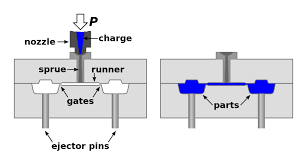
Why Gate Design Controls Sink Marks
Packing pressure only works while the gate is open and the thick section is still molten. If the gate freezes early, the cavity is isolated and shrinkage becomes a visible dent. A gate that is too small, too far from the thick region, or badly placed turns a moldable part into a cosmetic reject, no matter how the press is tuned.
Gate Types and Their Behavior
- Edge gate: simple and cheap, but freezes early and leaves a mark that needs trimming
- Fan and film gate: spread flow for flat parts and reduce orientation, at the cost of trimming
- Hot runner / valve gate: holds packing pressure longer and leaves minimal vestige
- Direct sprue gate: good for thick single-cavity parts but leaves a large witness mark
- Submarine gate: automatic degating for high volume, with limited size
Sizing the Gate for Packing
Gate cross-section should be sized from the part volume and wall thickness, not from habit. As a working rule, the gate thickness is often 50 to 70 percent of the wall it feeds, with depth increasing for thick sections. Shear rate at the gate must stay within the resin supplier’s window; too high causes jetting and blush, too low causes hesitation and short shots.
Location Rules That Reduce Sink
Place the gate so flow reaches the thickest section last, allowing packing to continue there. Avoid gating into a thin wall that feeds a thick rib, because the thin wall freezes first. Ribs should be thinner than the nominal wall, typically 50 to 60 percent, and bosses should be supported with gussets rather than thickened walls.
Process Settings That Support the Design
Gate design sets the ceiling, but settings decide the result. Hold pressure and hold time must exceed gate freeze time, which is verified with a gate freeze study: weigh parts at increasing hold times until weight stops rising. Higher mold temperature near the thick section slows skin formation and improves packing, while excessive melt temperature increases shrinkage.
Validation and Inspection
Inspect for sink under grazing light, since direct light hides shallow dents. Measure the affected area with a profile gauge or a dial indicator on a granite plate. Keep boundary samples of acceptable and reject conditions, and record the hold time and pressure that produced them.
Frequently Asked Questions
Can sink marks be removed by polishing?
Only for shallow cosmetic dents on unpainted parts. Polishing a textured surface destroys the grain, so process correction is preferred.
Does a bigger gate always help?
It helps packing but adds cycle time and trimming cost. Balance the two when sizing.
What if the gate must sit away from the thick area?
Use a hot runner or a flow leader to keep melt mobile, or redesign the thick section as a cored pocket.
Conclusion
Injection mold gate design is the first lever against sink marks, with process settings as the second. For related reading, see injection moulding background, our defect troubleshooting guide. Contact TCHD to review your tool layout.