


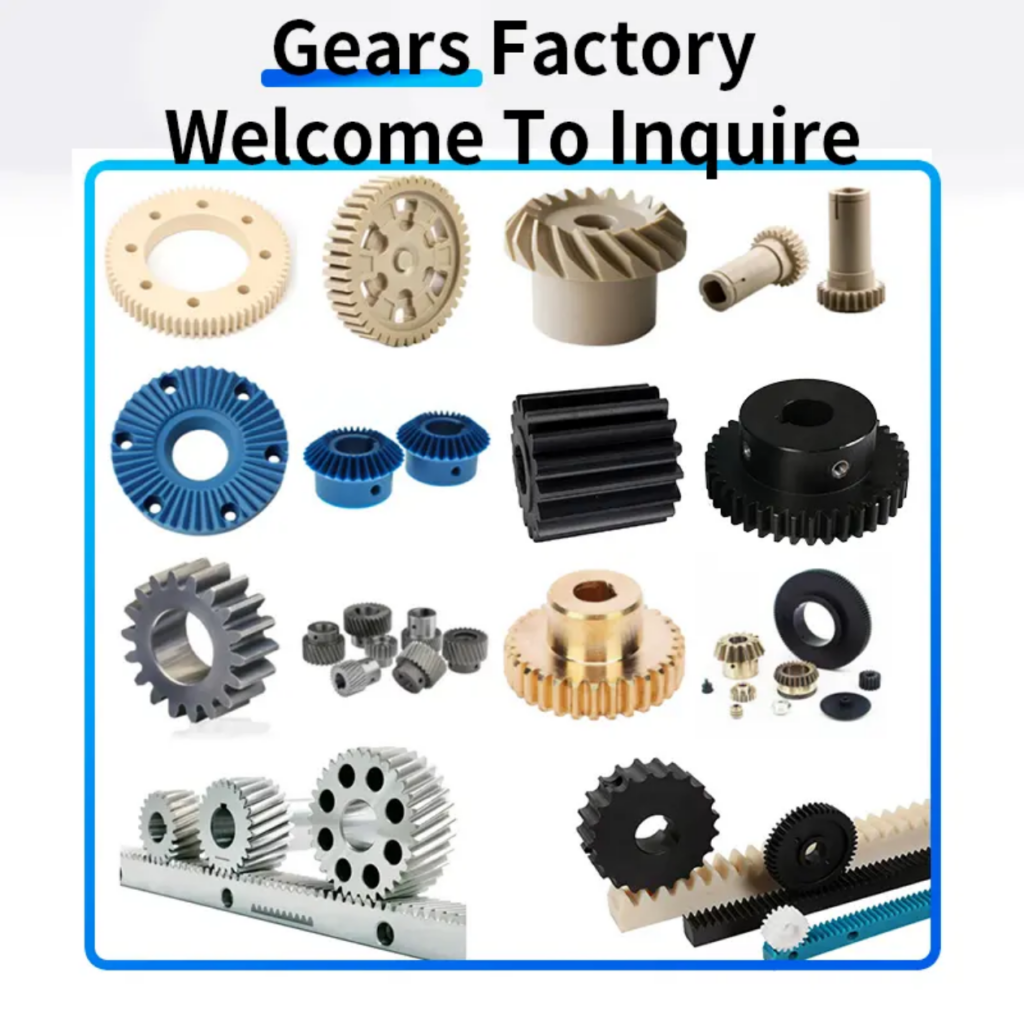
Plastic gears replace metal in many assemblies because they run quieter, resist corrosion, and can be molded with hubs and shafts in one part. The trade-off is that tooth accuracy, wear, and strength depend heavily on tooling and material choices made long before the first sample.
Material Selection for Gears
POM (acetal) is the default for precision gears because of low friction, good fatigue resistance, and dimensional stability. PA66 offers higher strength and heat resistance but absorbs moisture, which changes tooth dimensions. PBT and PEEK extend temperature and chemical limits at higher cost. Glass-filled grades increase stiffness but also increase wear on mating metal parts, so the pair should be evaluated together.
Tooth Accuracy and Shrinkage
Gear quality depends on tooth profile, spacing, and concentricity. Shrinkage varies with tooth thickness and flow direction, so a mold cut to nominal dimensions will not produce nominal teeth. Tool correction after the first sample is normal: measure the tooth profile, calculate the deviation, and adjust the electrode or wire path.
Gate Location and Weld Lines
A gate placed at the hub gives radial flow and reasonable symmetry, but creates a weld line opposite the gate. If that weld line lands on a loaded tooth, the gear fails there. Multi-point gating or a ring gate distributes flow and moves the weld away from the contact zone, at the cost of tooling complexity.
Design Rules
- Keep tooth thickness uniform to reduce warp
- Use a hub with a generous fillet at the web to spread load
- Provide draft on the tooth flank for clean ejection
- Allow clearance for moisture expansion in PA gears
- Specify the quality grade and the inspection method on the drawing
Wear and Lubrication
Plastic gears usually run dry or with light grease. The combination of materials matters: POM against POM wears well, while POM against PA can transfer material and fail. Surface finish on the tooth flank affects friction, and a polished cavity reduces break-in wear.
Inspection Methods
Composite inspection or a gear checker measures profile, lead, and spacing against the drawing. Runout and center distance are checked on a fixture. Functional testing on a loaded rig reveals noise and wear that dimensional inspection cannot show, and it belongs in the validation plan.
Frequently Asked Questions
Can plastic gears replace metal directly?
Often, with a redesign of tooth width and a check on load and temperature. Direct substitution usually fails on strength.
Why do molded gears run noisy?
Usually tooth spacing variation or center distance error rather than material choice.
Which resin is best for high load?
Glass-filled PA or PEEK, with the mating gear and lubrication reviewed at the same time.
Conclusion
Plastic gear injection molding succeeds when material, tooth tolerance, and gating are designed together. For related reading, see gear reference, our mold quality factors, and plastic material properties guide. Contact TCHD to review your gear part.