

Choosing an overseas mold maker is a decision about risk as much as about price. A quotation tells you what a tool costs; it does not tell you whether the design review will catch a wall thickness problem, whether the steel matches the resin, or whether the same part will arrive in month twelve as in month one. Experience is the proxy most buyers use for those answers, and it should be examined rather than assumed.
What Experience Actually Buys
A shop that has built thousands of tools has seen the failure modes that a new supplier only reads about: gate freeze-off on a thin wall, a slider that galls after two hundred thousand cycles, a texture that cannot be polished out of a tight corner. That knowledge enters the project during DFM review, which is the cheapest stage to change anything.
Design Review as the First Control
Ask what the supplier will question before quoting. Draft, uniform wall, weld line location, gate position in cosmetic zones, ejection marks, and tolerance stack against assembly are the basics. A supplier that only confirms the drawing is a machine shop; one that raises issues is a mold maker.
Certification and Quality Systems
ISO 9001 covers general quality management, IATF 16949 adds automotive process discipline, and ISO 13485 applies to medical devices. The certificate matters less than the records behind it: inspection plans, calibration logs, material certificates, and traceability from steel lot to shipped tool.
Equipment That Supports Tolerance
Mirror EDM, slow wire cutting, and high-speed machining determine what the shop can hold without hand work. A supplier with the right equipment can cut a shut-off to a few micrometers and leave a polish that needs no benching. Without it, tolerances depend on the skill of an individual rather than on a repeatable process.
Communication and Project Control
- Weekly photo and measurement updates during machining
- A named engineer who answers technical questions directly
- Documented DFM responses rather than verbal reassurance
- Trial report with process sheet and sample measurements
- A clear plan for tool transfer and spare parts
Total Cost, Not Unit Price
A cheaper tool that needs two extra trial loops, or that wears out at 100,000 cycles, costs more than a well-built one. Overseas sourcing risk shows up as freight delays, rework rounds, and production downtime, and those are rarely visible in a spreadsheet comparison. Evaluating cycle time, scrap rate, and maintenance expectation alongside price gives a truer number.
Longevity and Adaptation
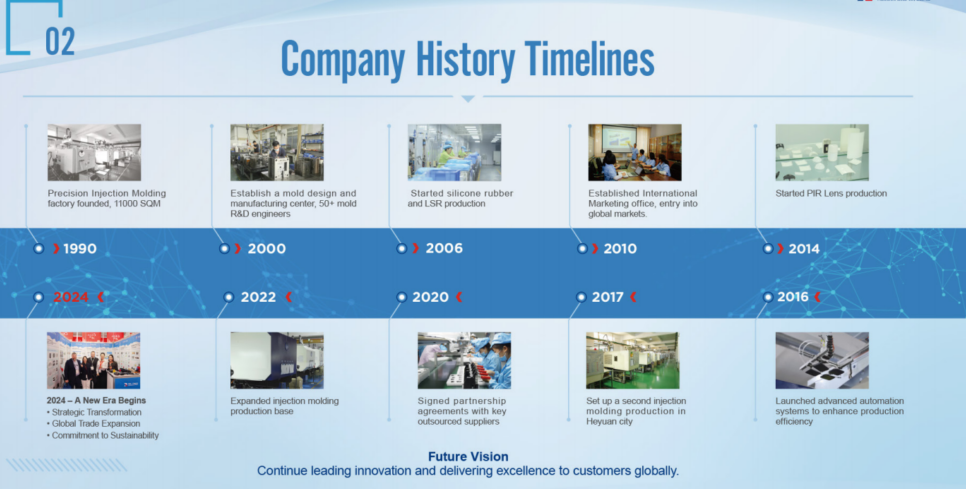
A supplier that has operated for decades has survived technology shifts, which is evidence of adaptation rather than inertia. Look for newer capabilities, such as liquid silicone or two-shot molding, alongside the traditional toolroom skills.
Frequently Asked Questions
How do I verify an overseas mold maker?
Request certification scope, recent tool lists with references, inspection records, and a video walkthrough of the shop floor.
Is a lower quote worth the risk?
Only if the scope matches. Compare steel grade, cavitation, hot runner brand, and trial support, not just the total.
What should be in the contract?
Tolerances, acceptance criteria, trial and sample quantities, documentation, spare parts, and payment tied to milestones.
Conclusion
An experienced overseas mold maker lowers risk by catching design problems early and holding tolerances through documented process control. For related reading, see injection moulding reference, our mold partner selection guide, and why cheap molds cost more. Contact TCHD to review your sourcing plan.