


Plastic tile manufacturing is a molding problem dressed as a building product. The tile must be flat, dimensionally consistent, resistant to the environment it is installed in, and easy to lock together. Each requirement maps back to a polymer choice, a tool design, and a process window that has to hold across a long production run.
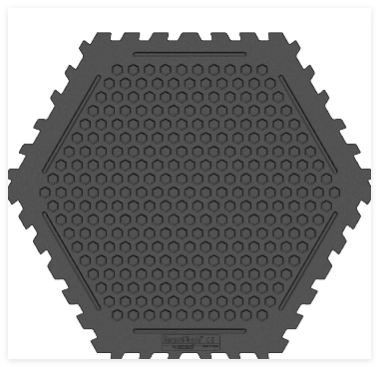
Choosing PP or PVC
Polypropylene offers chemical resistance, low moisture absorption, and good impact at low cost, which suits outdoor decking, drainage, and utility flooring. PVC adds flame resistance, a harder surface, and better dimensional stability under heat, which suits interior and decorative work. Both accept printing and coating, but the surface energy differs, so adhesion must be validated per material.
Design Rules for Flat, Stable Tiles
- Keep wall thickness uniform; thick ribs are the main cause of sink and warp
- Design the interlock so tolerance stack does not prevent engagement
- Add a hidden expansion gap for thermal movement in large installations
- Place ribs symmetrically so cooling is balanced on both faces
- Specify slip resistance by test standard, not by texture description
Tool Construction
Large flat parts demand rigid mold plates and even support, because any deflection shows as thickness variation. Cooling circuits should be close to the surface and balanced across the whole cavity; a tile that cools unevenly cups at the corners. For textured surfaces, the mold texture must be cut consistently across cavities so tiles from different positions match.
Plastic Tile Manufacturing: Process Control
Injection speed and packing pressure decide flatness as much as cooling does. Over-packing stresses the part and increases warp after ejection; under-packing leaves sink over ribs. A longer cooling time usually costs less than a rejected batch, and a fixture that holds the tile flat during cooling removes residual bow.
Warpage and Flatness
Flatness should be specified with a measurement method, a support condition, and a temperature, because a tile measured on a bench and a tile measured after installation give different results. Conditioning samples before inspection prevents disputes later.
Secondary Operations
Spray painting adds color and UV protection; screen printing adds patterns and branding. Both need a clean surface and an appropriate pretreatment, since polyolefin surfaces bond poorly without flame or plasma treatment. Lamination and co-extrusion are alternatives when a durable decorative layer is required.
Quality Checks
Inspection covers dimensions, flatness, interlock fit, color, surface defects, and slip resistance. Impact and load tests show whether the rib structure carries the intended weight. For outdoor products, accelerated UV exposure confirms that color and mechanical properties survive the service life.
Frequently Asked Questions
Are plastic tiles suitable for outdoor use?
PP tiles with UV stabilization are common outdoors. Unstabilized material chalks and embrittles within a season.
Why do tiles not lock together properly?
Usually interlock geometry combined with shrinkage variation, or warpage that changes the effective pitch.
Can plastic tiles carry vehicle loads?
Some industrial grades can, but rib design and substrate support must be engineered and load-tested for the application.
Conclusion
Plastic tile manufacturing depends on uniform walls, balanced cooling, and a tool built for flatness, not only for shape. For related reading, see tile reference, our virgin vs recycled plastic guide, and molding supplier selection. Contact TCHD to develop your tile program.