


Hollow injection molded parts demand early engineering attention because internal cavities and unsupported sections make them difficult to manufacture. Common risks include warpage, uneven shrinkage, sink marks, surface waviness, and dimensional instability. These defects can interfere with assembly, affect sealing performance, and reduce product lifespan, so design, material, process, and quality have to be reviewed before tooling begins.
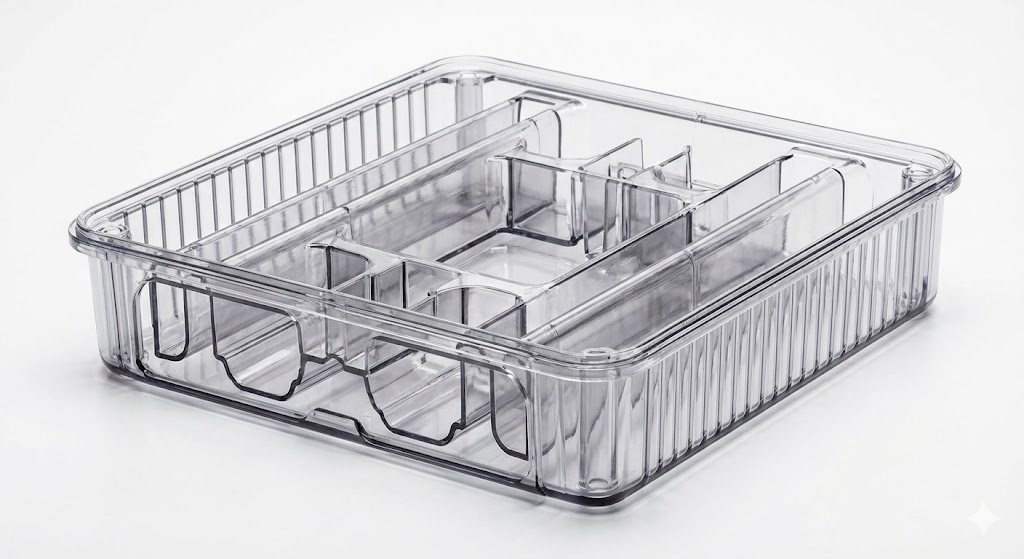
Why Hollow Injection Molded Parts Are Hard to Mold
A hollow part has walls on both sides of an empty space, and every wall shrinks as it cools. If the inner and outer walls differ in thickness, the part pulls in different directions and warps. If a thick section sits next to a thin one, the thick area stays molten longer, creating sink marks or internal voids. The geometry itself sets the difficulty, which is why hollow injection molded parts need a design review before steel is cut.
Design Rules for Stable Hollow Sections
- Keep wall thickness uniform: variation above roughly 20% invites warpage and sink
- Use ribs instead of thick walls: ribs add stiffness without adding mass
- Add draft on every vertical face: typically 1° or more to ease ejection
- Round internal corners: sharp corners concentrate stress and restrict flow
- Design the opening deliberately: the core that forms the cavity must be able to withdraw
Tooling Considerations
The core that creates the hollow space drives much of the tool design. Long, slender cores need cooling and support, or they deflect under injection pressure and produce wall-thickness variation. Gate position matters as well: feeding into a thin wall can freeze off before the cavity fills, while feeding into a thick section can cause overpacking. Where the hollow space is closed, collapsible cores or sliding mechanisms may be required.
Process Control for Even Shrinkage
Molding parameters should favor uniform cooling. Moderate injection speed, adequate packing pressure, and balanced mold temperature reduce differential shrinkage. Cooling time must be long enough for the inner wall to solidify; removing the part early causes post-mold warpage that appears hours later. Drying and melt temperature also matter, particularly for hygroscopic resins.
Quality Checks That Catch Hollow-Part Defects
Inspection should combine dimensional measurement with section checks. Cutting a sample part and measuring wall thickness at several points reveals drift that external gauges cannot see. Flatness and straightness checks catch warpage, while a simple leak or fit test confirms function. Keeping these checks in the control plan from the first trial avoids discovering problems at assembly.
Frequently Asked Questions
Can a hollow part be molded in one piece?
Yes, if the core can be withdrawn. Closed hollow shapes often need collapsible cores or split tooling.
Why does a hollow part warp after ejection?
Uneven wall thickness and premature ejection leave the inner wall cooling outside the mold, which pulls the part out of shape.
What wall thickness is practical?
It depends on material and part size, but uniform walls in the 1.5–3 mm range are common for structural hollow parts.
Conclusion
Hollow injection molded parts succeed when geometry, tooling, and process are planned together. For related design guidance, review collapsible core molds and injection molding defects, or send your drawing to TCHD for a technical review.