


Injection molding weld lines form where two flow fronts meet inside the cavity and fail to fuse into a single, uniform material. On cosmetic parts the result is a visible line; on high-performance parts such as LCP connector housings, it can become a crack initiation site that survives tooling adjustments and only shows up in the field. Understanding why injection molding weld lines weaken a part is the first step toward a durable fix.
Why Injection Molding Weld Lines Weaken LCP Connectors
Liquid crystal polymer (LCP) offers high stiffness, low warpage, and excellent dimensional stability, which is why it is widely used in fine-pitch connectors. Those same properties make weld lines more critical. When two melt fronts meet, the polymer chains at the interface do not entangle as fully as in the bulk material. The joint can lose a significant share of its tensile strength, and in thin walls the effect is amplified. A connector that passes a visual check may still crack under mating force, thermal cycling, or vibration.
Case Study: Cracking in an LCP Connector Housing
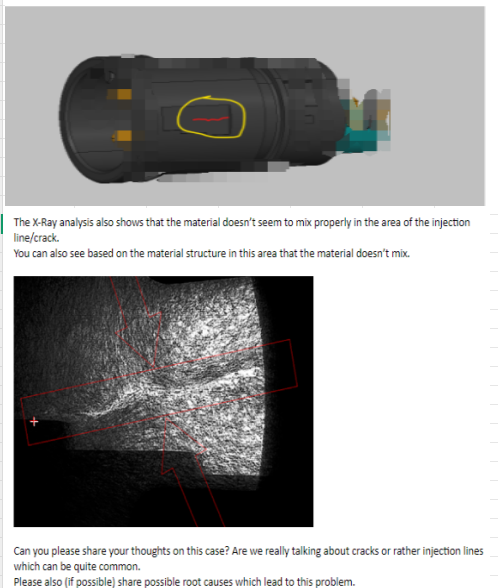
A manufacturing partner had already made several tooling adjustments, but recurring cracks continued to appear in an LCP connector housing. The team requested a deeper technical review to understand what was happening inside the molded part. X-ray analysis showed that the material was not mixing properly near the injection line, and the client wanted possible root causes and corrective solutions.
Root Causes Identified
The review identified three connected problems:
- The thin-walled design relied on a single-gate flow path, which created a weak weld line opposite the gate.
- Microscopy and X-ray confirmed incomplete material fusion at the joint.
- Process parameters were not optimized for LCP, so melt temperature and injection speed did not support a strong interface.
Solutions: Design and Process Fixes
The recommended solution combined tooling and processing improvements. The mold design was revised toward multi-gate feeding to shorten flow length and move the weld line to a lower-stress area. Process settings were then fine-tuned for temperature, pressure, and cooling rate. The team also provided LCP-specific material guidance to align production with the polymer’s behavior.
Preventing Future Weld Line Defects
Teams can reduce risk by reviewing gate location and flow balance during mold structure design, by validating fill with simulation, and by defining weld-line acceptance criteria before production. When undercuts complicate the flow path, injection mold lifters and sliders should be evaluated together with gate position. A practical checklist of injection molding defects helps quality teams catch these issues early.
How to Test Weld Line Strength
Weld-line strength is easy to overlook because a part can look perfect and still fail. A structured test plan should combine three checks. First, visual and microscopic inspection locates the weld line and reveals surface notches. Second, non-destructive methods such as X-ray or ultrasonic scanning show internal voids and incomplete fusion. Third, mechanical testing—tensile, flexural, or a simulated mating cycle—quantifies how much strength the joint retains. Comparing a part molded with a single gate versus a multi-gate layout makes the improvement measurable. When testing LCP connectors, fixtures should mimic the real mating force, because a weld line that survives a slow pull may still crack under repeated insertion. Documenting these results also gives quality teams a baseline for future production.
Frequently Asked Questions
Can a weld line be eliminated completely?
Not always. The goal is usually to move it to a non-critical area and ensure the interface is strong enough for the application.
Does higher melt temperature always help?
Up to a point. Too high a temperature can degrade LCP. The right window must be established with a molding trial.
How do you inspect a weld line?
Visual checks catch cosmetic lines, but X-ray, microscopy, and mechanical testing are needed to confirm fusion quality.
Conclusion
Weld lines are a design, material, and process issue at the same time. Treating them as a single-variable defect usually leads to repeated adjustments. A structured review of flow, tooling, and polymer behavior resolves the root cause. For LCP and other high-performance resins, see our notes on liquid crystal polymer and contact TCHD to review your connector design.