


Plastic is the right starting point for many products because it is adaptable, economical, and easy to mold. Some designs, though, only reveal their limits once real conditions apply: a part cracks under load, loses grip, fails to seal, or degrades in a harsh environment. In those cases the answer is often not a different plastic but a custom rubber component engineered for the duty.
Where Plastic Reaches Its Limits
Rigid thermoplastics are stiff by design. When a part must flex repeatedly, compress to seal, absorb shock, or survive continuous UV and chemical exposure, a plastic grade that meets those needs usually gives up something else such as dimensional stability or cost. Rubber fills that gap with high elongation, elastic recovery, and broad temperature tolerance.
Custom Rubber Parts by Function
- Sealing: O-rings, gaskets, and molded seals that hold pressure and exclude water or dust
- Grip: buttons, handles, feet, and overmolded surfaces that feel secure in use
- Damping: mounts and isolators that absorb shock and vibration
- Protection: boots, covers, and bumpers that deflect impact and abrasion
Choosing the Right Elastomer
Silicone handles wide temperature range and offers good electrical insulation and biocompatibility options. EPDM resists UV, ozone, and weather, which suits outdoor sealing. Nitrile (NBR) resists oils and fuels and is common in automotive fluid systems. Neoprene balances weather and oil resistance. Fluorosilicone and FKM extend chemical and heat limits at higher cost. Selection should follow the actual fluid, temperature cycle, and compression set requirement rather than a generic preference.
Design Rules That Prevent Failure
Rubber behaves differently from rigid plastic. Sections should avoid sharp internal corners, and radii should be generous to reduce stress concentration. Compression set depends on squeeze percentage, so groove design must leave room for thermal expansion. Bonded rubber-to-plastic parts need a defined bond line and a substrate surface prepared for adhesion. Draft and parting line placement should be agreed early, because flash on a sealing face is a leak path.
Production Routes and Tolerances
Compression molding suits large or low-volume parts, transfer molding improves consistency for mid volume, and liquid silicone rubber injection molding supports high volume with tight tolerances and short cycles. Rubber tolerances are wider than machining tolerances by nature; specifying them realistically avoids cost that adds no function. Hardness (Shore A), tensile strength, elongation, and compression set should appear on the drawing together with the test standard.
Combining Plastic and Rubber
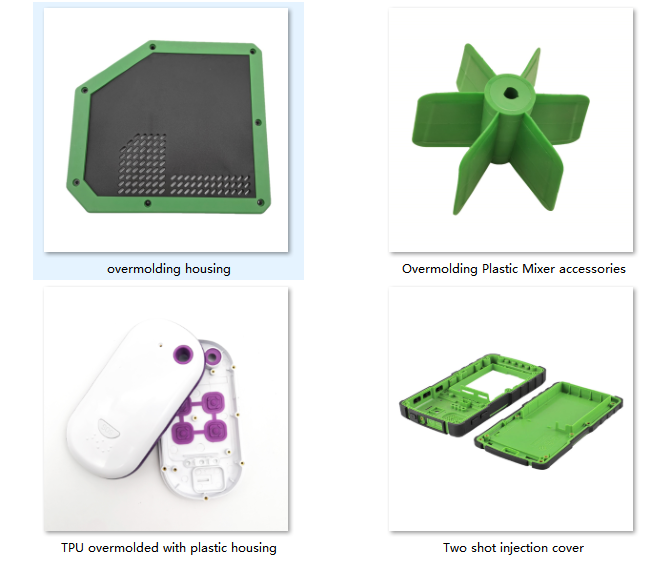
Many products work best with structural plastic and functional rubber in one assembly. Overmolding, insert bonding, or mechanical retention can join them, and the choice depends on bond strength, cycle count, and whether the parts must separate for recycling.
Frequently Asked Questions
Can rubber replace plastic entirely?
Rarely. Rubber lacks the stiffness and dimensional precision of engineering plastics, so most designs combine both materials.
What is the typical lead time for custom rubber parts?
Prototype tooling can be quick, while production molds with LSR injection usually need several weeks including trials.
How do I specify hardness?
State Shore A durometer with a standard and tolerance, and note whether the value applies to the finished part or the compound slab.
Conclusion
Custom rubber parts extend a plastic design where sealing, grip, damping, or harsh service are required. For background, see elastomer reference, our medical silicone molding guide, and hollow molded part design. Contact TCHD to review your material pair.