


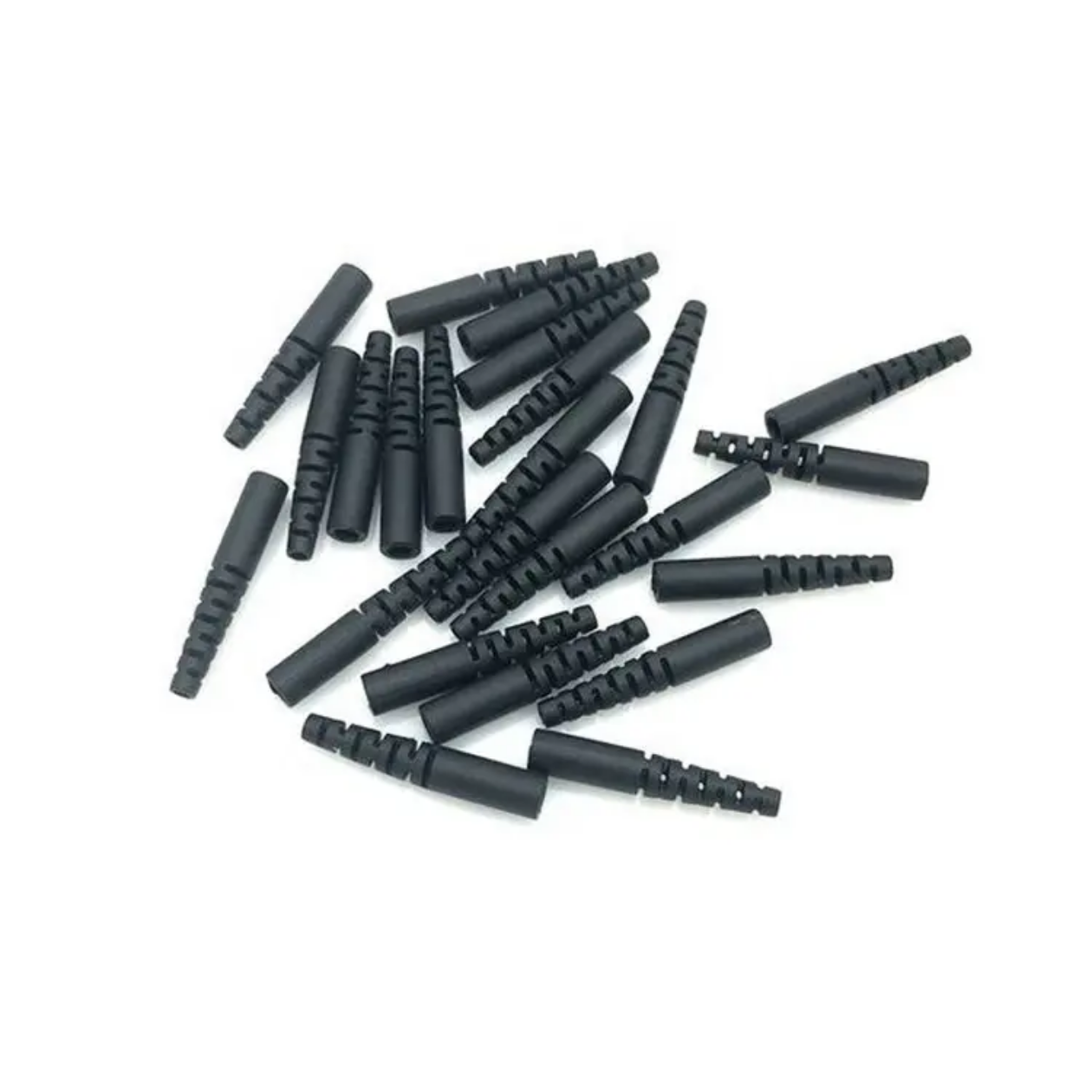
Fiber optic connectors carry signals at tolerances measured in microns, yet the cable they attach to is handled roughly in the field. The boot is the part that absorbs that handling. A well-designed TPE boot protects the fiber from bending below its minimum radius while keeping the connector seated and sealed.
What the Boot Must Do
The boot provides strain relief, limits bend radius, and seals the connector body against dust and moisture. It must also stay flexible across temperature so it does not crack in cold or soften in heat. In data centers and outdoor cabinets, those requirements run simultaneously.
Why TPE Fits the Application
Thermoplastic elastomers offer a tunable hardness range, good tear resistance, and clean overmolding onto connector bodies. They can be formulated for low smoke and halogen-free compliance, which matters in enclosed equipment. Compared with silicone, TPE bonds more easily to engineering plastics and costs less at volume.
Design Rules for Bend Relief
- Provide a gradual taper rather than a sharp step at the connector
- Keep the boot length long enough to control the bend radius
- Add internal ribs or a bellows section for flexibility
- Avoid sharp internal corners that concentrate stress
- Specify retention force so the boot stays seated during pull
Material Grade Selection
Shore hardness usually falls between 60A and 85A for cable boots. Softer grades flex more but can tear at the connector interface; harder grades protect the fiber better but resist routing. Flame-retardant and low-smoke grades are specified for indoor enclosures, and UV-stabilized grades for outdoor installations.
Overmolding and Bonding
The boot is often overmolded directly onto the connector body or the cable jacket. Bond strength depends on substrate compatibility and surface preparation. Where the boot must be removable, a mechanical retention feature replaces chemical bonding.
Validation Testing
Tests typically include bend cycling at the specified radius, pull force on the cable, temperature cycling, and ingress protection. Optical loss is measured before and after mechanical tests, because a boot that passes a pull test can still pinch the fiber. Field complaints often trace to a bend radius that was too tight rather than to material failure.
Frequently Asked Questions
Can a TPE boot replace a silicone boot directly?
Usually with a hardness and geometry review, since silicone and TPE behave differently in cold flex.
What hardness is typical?
Around 70A balances flexibility and tear resistance for most cable diameters.
Does the boot affect optical performance?
Only if it forces a bend below the fiber’s minimum radius. That is a design issue, not a material one.
Conclusion
TPE fiber optic connector boots protect both the fiber and the connector when geometry and hardness are matched to the cable. For related reading, see fiber-optic connector reference, our silicone vs TPE guide, and LSR vs plastic overmolding. Contact TCHD to develop your boot.