


PBT plastic is the quiet workhorse of electrical and automotive moulding. It is rarely the headline material in a design review, yet it holds connectors, sensor housings, motor end caps, and pump components that must survive solder heat, fuel, and ten years of thermal cycling. Understanding PBT plastic properties explains why it keeps winning those jobs against cheaper and more glamorous alternatives.
Table of Contents
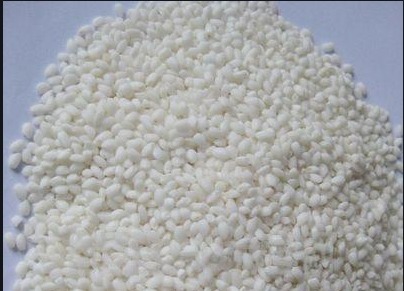
The short version: PBT plastic is a semi-crystalline polyester with good strength, excellent electrical behaviour, low moisture absorption, and a strong resistance to most solvents. It is not tough in the way polycarbonate is tough, and it does not like hot water or strong bases. Within those limits it is one of the most predictable engineering thermoplastics available.
What PBT Plastic Is
Polybutylene terephthalate is a condensation polymer of terephthalic acid and 1,4-butanediol. The aromatic ring in the backbone gives stiffness and a high melting point around 225 degrees Celsius. The flexible butylene segment gives fast crystallisation, which is why PBT plastic sets quickly in the mould and cycles faster than PET.
That fast crystallisation is commercially important. A PBT part can be demoulded at a higher temperature than an equivalent PET part, which shortens the cycle without introducing the dimensional instability that comes from quenching an under-crystallised part. For high-volume connectors, the difference in cycle time is worth more than the difference in resin price.
PBT plastic is also almost always compounded rather than used neat. Glass fibre, mineral filler, flame retardants, impact modifiers, and release agents are added to reach a property set that the base resin alone cannot deliver. Reading a data sheet without reading the grade designation is therefore a common source of design error.
The Properties That Matter
Strength and stiffness. Unfilled PBT plastic typically shows a tensile strength around 50 to 60 MPa and a modulus near 2.5 GPa. With 30 percent glass fibre, strength rises to roughly 120 to 140 MPa and the modulus to around 9 GPa, at the cost of ductility and surface finish.
Creep resistance. PBT plastic holds load better than PA66 at elevated temperature because it absorbs far less moisture. A connector that must maintain contact force for a decade is a much safer design in PBT than in an unfilled nylon.
Electrical behaviour. Volume resistivity, dielectric strength, and comparative tracking index are all strong in the unfilled grades, and the flame-retardant grades used in switchgear are formulated to keep them. This is the main reason PBT plastic dominates low-voltage insulation.
Chemical resistance. PBT plastic resists fuels, oils, greases, and most cleaning solvents. It does not resist strong alkalis, and it hydrolyses in prolonged hot water, which rules it out of some plumbing and dishwashing applications.
Temperature. Continuous use is generally quoted between 100 and 140 degrees Celsius depending on grade. Short excursions during soldering are survivable, but the number of reflow cycles belongs in the specification, not in an assumption.
Toughness. Notched impact strength is modest. Impact-modified grades improve it considerably, and they are the right choice for clips, latches, and parts that see handling abuse.
Moisture, Shrinkage, and Dimensional Control
PBT plastic absorbs around 0.1 to 0.4 percent moisture at saturation, roughly an order of magnitude less than PA66. That single number explains most of the dimensional advantage. A PBT plastic part moulded to tolerance stays close to that tolerance in service, while a nylon part grows after moulding and again after conditioning.
Shrinkage is the other half of the story. Unfilled PBT plastic shrinks about 1.5 to 2.2 percent, and 30 percent glass-filled grades shrink around 0.2 to 0.6 percent in the flow direction but noticeably more across the flow. That anisotropy is the source of most warpage complaints, and it is managed by gate position, wall uniformity, and packing rather than by adding pressure at the end of the cycle.
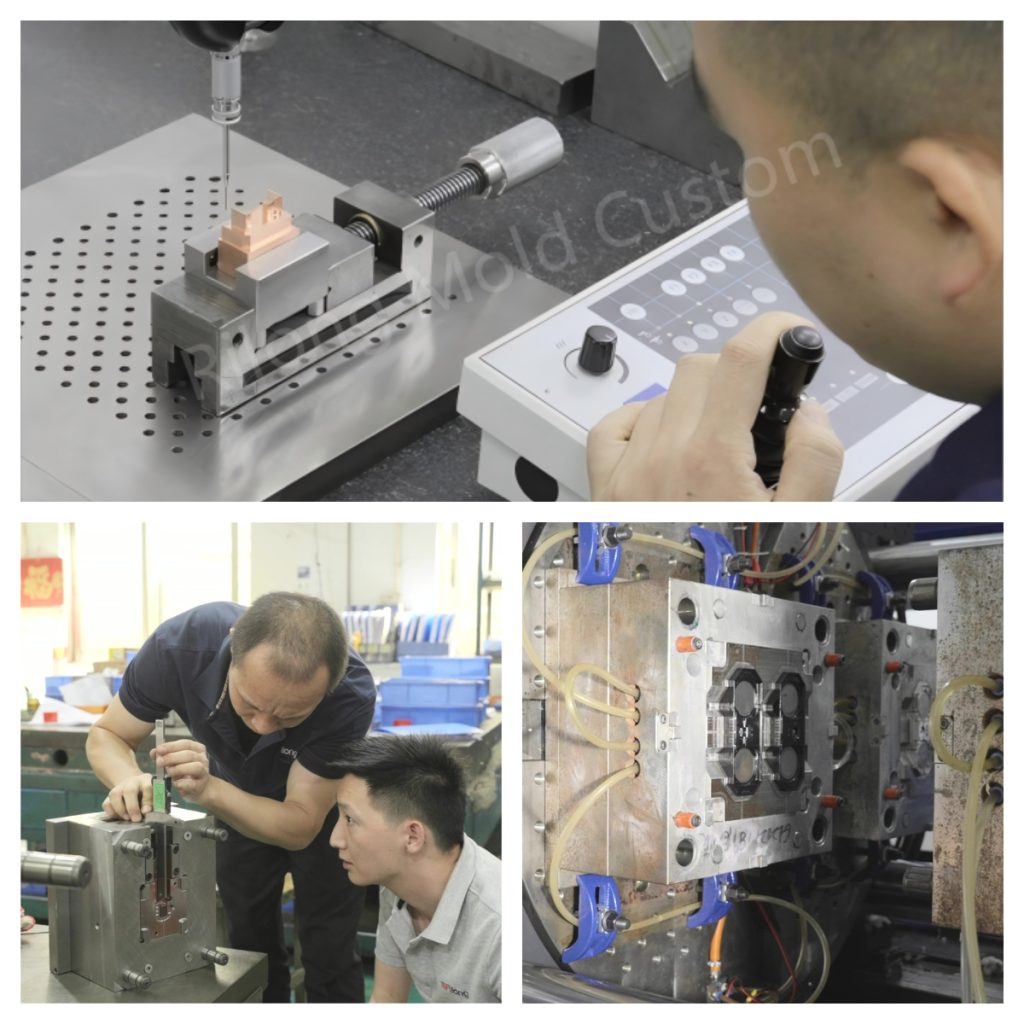
Mould temperature has a direct effect on both shrinkage and surface. A hot mould, typically 80 to 100 degrees Celsius, produces better crystallinity, lower post-mould shrinkage, and a glossier surface. A cold mould produces a part that looks acceptable and moves later, which is the more expensive outcome.
Grades and What Each One Buys
Unfilled. The best surface, the best toughness, and the lowest cost. Used for housings, covers, and parts that do not carry structural load. Shrinkage is high and anisotropic behaviour is modest.
Glass-filled, 15 to 30 percent. The default for structural and dimensional work. Stiffness and creep resistance improve sharply; weld lines become weak points; surface finish becomes matte and slightly fibrous.
Mineral-filled. Lower warpage than glass, lower strength, and a better surface. Often chosen for large flat parts where dimensional stability across the flow matters more than peak load.
Flame retardant. Halogenated and halogen-free systems both exist. They reduce toughness and often reduce tracking resistance, so the electrical grade must be selected against the actual standard, not against a generic claim.
Impact modified. Adds rubbery domains that raise notched impact. Useful for latches and covers, at some cost in stiffness and colour stability.
Each of these is still PBT plastic, and the properties that survive compounding are the ones designers rely on: low moisture, good electricals, and predictable crystallisation. The properties that change are the ones that decide which grade the drawing names.
Processing Window
Drying comes first. PBT plastic is less hygroscopic than nylon, but it still hydrolyses if moulded wet. Four hours at 120 degrees Celsius in a desiccant dryer is the usual starting point, and a moisture meter on the hopper is worth more than a schedule on the wall.
Melt temperature typically sits between 240 and 265 degrees Celsius. Below that range the melt is stiff and short shots appear; above it the resin degrades, and the first sign is usually a brittle part rather than a visible defect. Residence time matters as much as temperature, so a large barrel running a small shot is a risk.
Injection speed should be high enough to fill before the gate freezes, with the profile tapered toward the end of fill to avoid flashing. Packing pressure is set from part weight, not from the pressure gauge, because the two diverge as viscosity changes through the shift.
Mould temperature between 70 and 100 degrees Celsius balances cycle time against crystallinity. Cooling time is usually set from the thickest section, and a part that is ejected too hot will warp in the fixture even if it measured well in the tool.
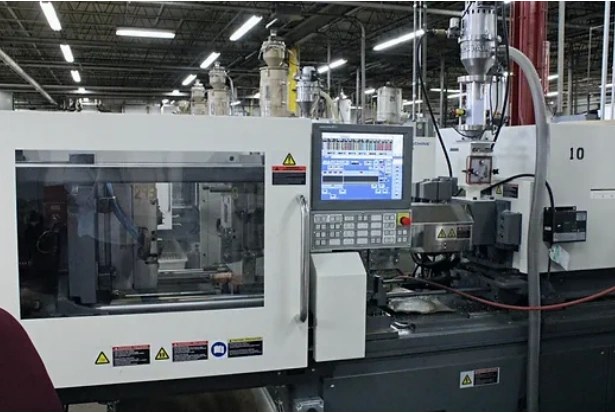
Cycle time on a PBT plastic job is usually set by the thickest wall, not by the gate. Because the resin crystallises quickly, the cooling phase can often be shortened, provided the ejector side is supported and the part is not being pulled off a hot core. Measuring the part immediately after ejection, and again after twenty-four hours, tells you whether the cycle is genuinely stable or merely fast.
Regrind handling deserves a written rule. PBT plastic tolerates regrind at moderate ratios, but the material that comes back from a sprue has a different thermal history and a shorter molecular chain. Blending it consistently, rather than dumping it back into the hopper whenever a bin fills, is the difference between a stable process and a slow drift in dimensions.
Seven Design Rules
1. Keep walls uniform and thin enough to cool
Nominal walls of 1.5 to 3 mm suit most PBT plastic parts. A thick section cools slowly, shrinks more, and creates sink marks on the visible face no packing pressure can remove.
2. Design ribs at 50 to 60 percent of wall thickness
Thicker ribs pull material from the wall and print a sink line on the opposite surface. A small draft on the rib sides helps ejection and reduces stress.
3. Place gates where weld lines will not carry load
Glass-filled PBT plastic develops weak weld lines because the fibres do not knit. If a weld line must cross a structural zone, move the gate and verify with a fill analysis.
4. Allow for anisotropic shrinkage in the tool
Glass-filled grades shrink differently along and across flow. The tool should be cut with that difference applied, which is why a shrink rate from a generic data sheet is not a tooling instruction.
5. Radius every internal corner
Sharp corners concentrate stress, and PBT plastic is not forgiving in that respect. A radius of half the wall thickness is a reasonable minimum for load-bearing corners.
6. Specify the finish you actually need
Glass-filled PBT plastic will not produce a Class A surface without a painted or textured treatment. Texturing the tool hides flow marks and is cheaper than polishing a part that will never be glossy.
7. Design for the assembly, not only the part
Self-tapping screws, ultrasonic welds, and press fits all behave differently in filled and unfilled grades. Boss diameter, screw type, and weld energy belong in the same drawing revision as the wall thickness.
PBT Plastic Against PA, PET, and ABS
Against PA66, the trade is clear. PA66 is tougher and cheaper per kilogram, and it absorbs enough moisture to change dimensions by tenths of a millimetre. PBT plastic wins where the tolerance must hold and the part must stay stiff when wet. Against PA6 the moisture gap is even wider.
Against PET, PBT crystallises faster, which means shorter cycles and less sensitivity to mould temperature. PET has a slightly better surface and better dimensional stability in some grades, but the processing window is narrower.
Against ABS, PBT plastic is stronger, far more chemically resistant, and much better in electrical applications. ABS is cheaper and easier to paint, which is why cosmetic covers still use it. Our guide to ABS, PA6, PC, and PP properties covers that side of the comparison in detail.
Failure Modes Worth Designing Out
Hydrolysis. Prolonged exposure to hot water or steam degrades the ester bond. If the part sees steam cleaning, PBT plastic is the wrong family, and no grade will fix it.
Warpage from anisotropic shrinkage. Usually a gate or wall problem rather than a resin problem. A fill and packing analysis before the tool is cut costs far less than a re-cut cavity.
Brittle weld lines in glass-filled parts. Design the gate so the weld is not in a load path, and verify with a burst or drop test on the first article.
Over-drying and devolatilisation. Unusual but real: resin left for days at high temperature in a hopper loses additives and processes differently. Dry to specification, not indefinitely.
Flame-retardant bloom. Some FR systems migrate to the surface and leave a film that interferes with printing and laser marking. Test the decoration process on production parts, not on plaques.
Frequently Asked Questions
Is PBT plastic suitable for outdoor use?
With stabilization, yes, for many applications. Unstabilised grades yellow and lose impact strength under UV. For long outdoor exposure, a stabilized grade plus a coating is the safer specification.
Can PBT plastic be recycled?
It can be reground and reused at modest ratios, typically up to 20 to 30 percent, provided the material has not degraded and the grade is not critical for electrical tracking. Regrind ratio belongs in the process specification.
Why does my PBT part crack at the insert?
Usually a combination of hoop stress from an oversized insert, a sharp corner, and low mould temperature. Warm the insert, increase the boss diameter, and add a radius before changing the resin.
The Bottom Line
PBT plastic earns its place through low moisture absorption, strong electrical properties, and fast, predictable crystallisation. Design within its limits, respect the anisotropy of filled grades, and dry the resin properly, and it will hold tolerance for the life of the product.
For background, the polybutylene terephthalate reference covers the chemistry, and our injection moulding process guide covers the tooling decisions that turn a good grade choice into a good part. Teams comparing connectors should also read injection moulding defects before the first trial.