


Telephone injection molding is a set of parts that must work as one product: a housing that feels solid, keys that actuate crisply, a window that stays clear, and light pipes that carry LED output evenly. Each part has its own tolerance chain, and the assembly decides whether the set succeeds.
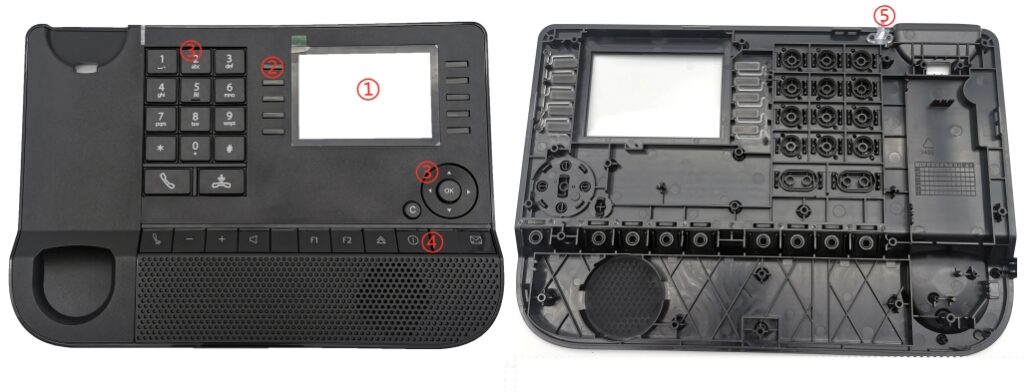
Telephone Injection Molding: The Part Set and Materials
Housings usually use ABS or PC-ABS for impact strength and finish; transparent windows and light pipes need optical-grade PC or PMMA with low haze. Key buttons are often ABS or PC with a textured or polished face, and where soft touch is required, a TPE or silicone pad sits underneath. Material pairs should be chosen together, since welding and snap fits depend on compatibility.
Tooling for Cosmetic Housings
Visible surfaces need polished cavities, balanced gating, and draft that does not show as a highlight. Gate position should be hidden behind a battery cover or a label recess. Texture is applied to the tool, so the steel must be finished consistently across cavities, or parts from different cavities will not match under the same light.
Light Pipes and Window Lenses
Optical parts fail on haze, flow lines, and internal stress. Drying the resin, using a hot runner with a clean melt path, and avoiding abrupt thickness changes all reduce optical defects. Light pipes need total internal reflection, so any scratch, sink, or weld line along the path becomes a visible bright or dark spot.
Controlling Stress in Transparent Parts
Packing pressure and cooling uniformity decide residual stress, which shows as birefringence and can cause crazing later. Annealing after molding relieves stress in lenses that must survive drop and thermal cycling.
Key Buttons and Tactile Feel
Key feel comes from the geometry of the button, the dome or switch beneath it, and the clearance in the housing slot. A slot that is too tight binds; too loose and the key rattles. Rear key slots machined to a controlled depth give a crisp, consistent press, and key travel should be verified on an assembled unit rather than on loose parts.
Assembly: Ultrasonic Welding and Snap Fits
Housings are usually joined by ultrasonic welding, screws, or snap fits. Welding gives a sealed, tamper-resistant joint but requires a designed energy director and consistent joint geometry. Snap fits allow service access but add a stress point that must be checked for whitening after repeated cycles.
Integrating Molding and Assembly
When molding, welding, and final assembly run under one roof, tolerance problems surface early and can be fixed in the tool instead of in a rework station. That integration is the practical difference between a set of good parts and a product that assembles reliably.
Quality Checks
- Dimensional check on housing mating faces and key slots
- Appearance under defined lighting for flow marks and color match
- Transmission and haze on windows and light pipes
- Key actuation force, travel, and life cycling on assembled units
- Drop and weld-strength tests on finished products
Frequently Asked Questions
Which plastic is best for a telephone housing?
ABS or PC-ABS for most designs; PC where impact strength and clarity of finish matter more than cost.
Why do light pipes look uneven?
Usually flow lines, sink, or surface scratches interrupting total internal reflection rather than an LED problem.
Can keys be molded in one shot with the housing?
Rarely. Separate buttons give better feel and allow different finishes, at the cost of an assembly step.
Conclusion
Telephone injection molding succeeds when housing, keys, optics, and assembly method are developed as one tolerance chain. For related reading, see telephone reference, our ultrasonic welding guide, and PC translucent molding guide. Contact TCHD to develop your product.