


Parts with threaded features force a manufacturing decision that shapes quality, speed, and total expense. The two common routes are in-mold threading and manual thread cutting, and they fit different project profiles. Choosing well depends on volume, tolerance, tooling budget, and how much handling the part can tolerate.
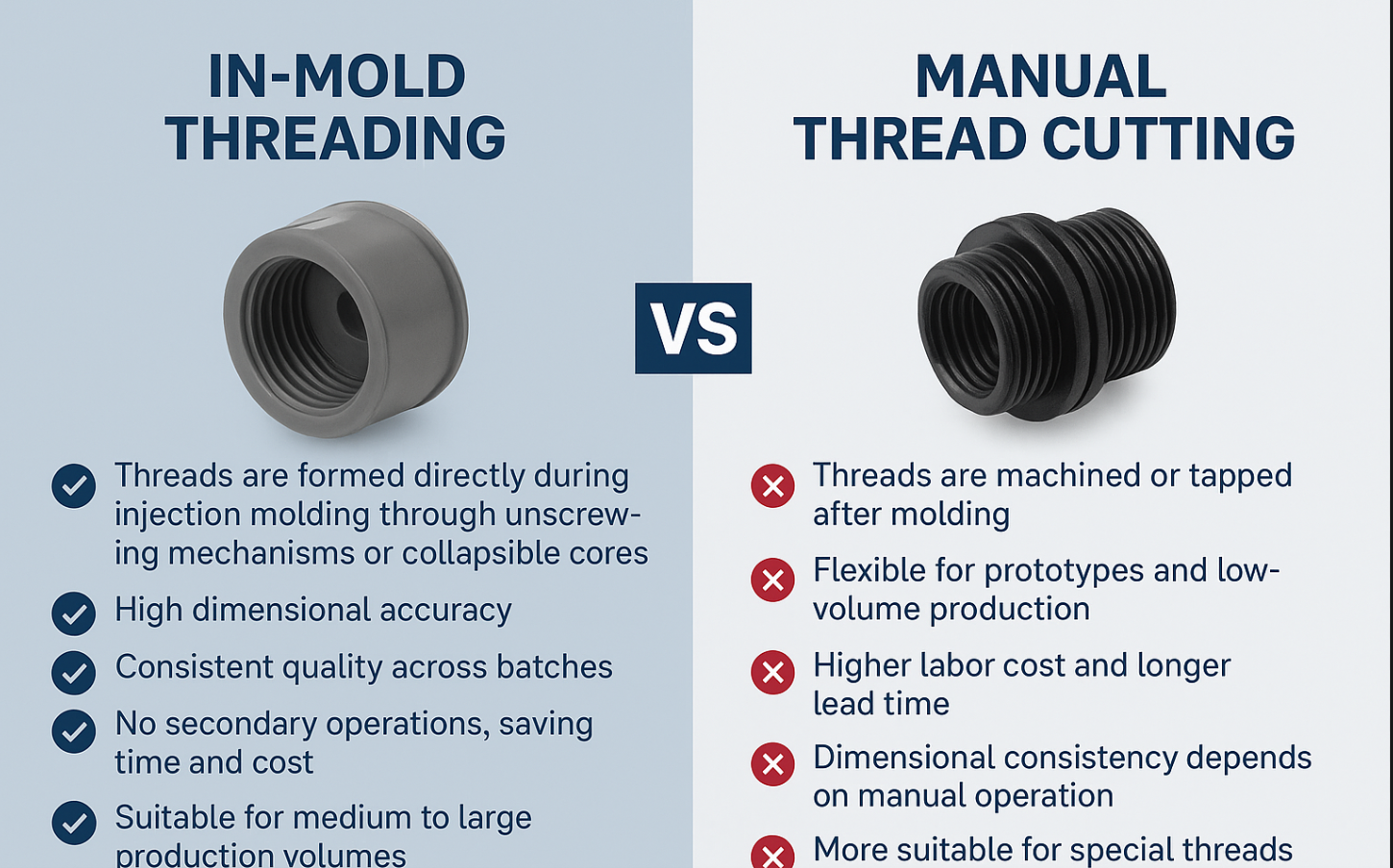
How In-Mold Threading Works
Threads are formed during molding by an unscrewing mechanism, a collapsible core, or a rotating cavity. The tool forms the thread while the part is produced, so dimensional accuracy is set by steel rather than by an operator. Because the thread is complete when the mold opens, no secondary operation is needed, which removes handling time and the scrap that manual tapping often creates.
How Manual Thread Cutting Works
Threads are machined or tapped after molding as a separate step. The method is flexible for prototypes, low volumes, and unusual thread specifications. The trade-offs are labor input, longer lead time, and consistency that depends on operator execution and tap wear. Thread flutes, chip clearance, and cross-threading all need attention.
Cost Comparison Over Volume
In-mold threading needs a more complex tool with gears, racks, or hydraulic drives, which raises the tooling price and the mold maintenance burden. Manual cutting needs a simpler tool but adds a per-part operation cost. The break-even point typically sits at medium volume: below it, the simpler tool plus secondary operation is cheaper; above it, the elimination of a handling step usually wins.
Tolerance and Strength Considerations
Molded threads usually follow coarse or custom profiles suited to plastic, and their strength depends on material, engagement length, and wall thickness around the thread. Metal inserts, either molded in or installed thermally, are preferred where repeated assembly or high torque is expected. Material choice matters as well: glass-filled resins hold threads better but wear the tool faster.
Design Details That Prevent Problems
- Add a lead-in chamfer to reduce cross-threading at assembly
- Keep wall thickness around the thread uniform to limit sink
- Allow a thread runout zone so the last turn does not distort
- Confirm parting line placement does not cut across the thread crest
- State the inspection gauge and the torque test method
Frequently Asked Questions
Can threads be molded in a two-plate tool?
Only if they can be released by straight pull, which is rare. Most threads need unscrewing, collapsing, or side action.
Is manual tapping acceptable for production?
It can be, at low volume, when inspection is defined and the risk of chips is controlled.
Which option suits prototype quantities?
Manual cutting is usually the practical choice, since it avoids investing in an unscrewing mechanism before the design is settled.
Conclusion
In-mold threading pays back when volume justifies the added tooling, while manual cutting keeps small runs flexible. For related reading, see tap and die reference, our cycle time guide, and injection mold cost drivers. Contact TCHD to select the route for your part.