


Automotive LSR—liquid silicone rubber used in vehicle components—is increasingly chosen because it combines elasticity with high thermal and chemical stability. Automakers are pursuing lighter, safer, and longer-lasting vehicles, and LSR helps them seal, cushion, and protect sensitive systems without adding weight. For engineers and sourcing teams, the material is not just a compound choice; it affects part design, tooling, process windows, quality control, and production planning.
Why Automotive LSR Is Growing
Under-hood temperatures rise, sensors multiply, and electric vehicles add new sealing and insulation demands. LSR holds its properties across a wide temperature range, resists fluids and aging, and stays flexible in thin sections. Those traits make it a natural fit for connectors, seals, gaskets, and soft-touch interfaces.
Performance Properties of Automotive LSR
Several performance traits make LSR useful across the vehicle. It can resist demanding temperatures and chemical exposure, absorb vibration, provide a durable soft-touch surface, maintain optical clarity, and bond to other substrates in over-molded assemblies.
Key Automotive LSR Applications
Sealing components rely on LSR’s ability to hold their shape under temperature swings and fluid exposure. Anti-vibration parts use its elasticity to reduce noise and vibration, while soft-touch controls benefit from a durable tactile feel under repeated use. High-clarity LSR also supports lenses for lighting and ADAS sensors, where optical performance matters.
LSR Over-Molding for Hybrid Parts
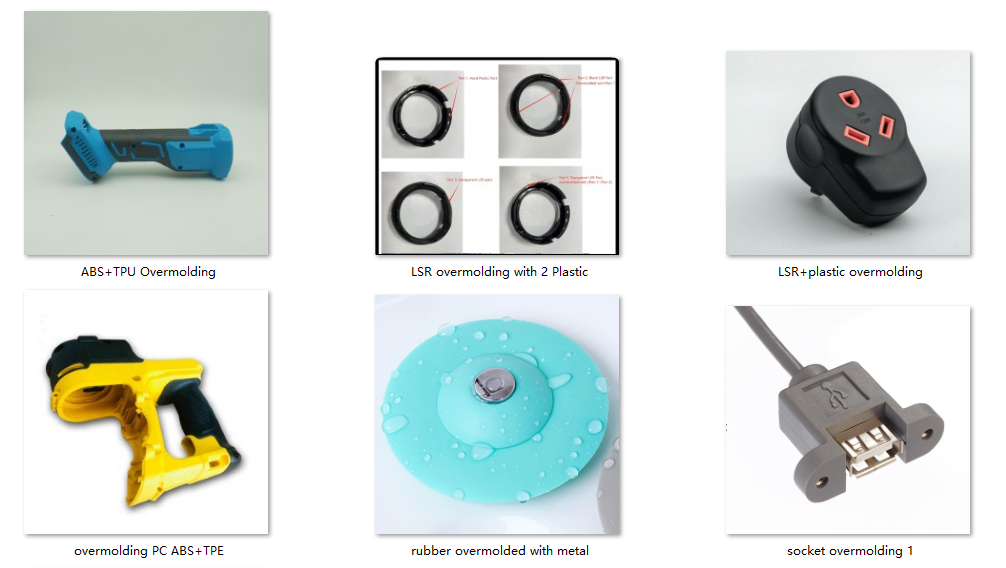
LSR over-molding expands design options by bonding silicone to plastic or metal substrates. This creates hybrid parts such as connectors, seals, and buttons with combined properties. Successful programs consider substrate compatibility, surface preparation, mold design, bond strength, flash control, cycle time, and inspection criteria.
Projects often compare LSR double injection molding with LSR versus plastic overmolding, and review the base material properties in the LSR properties guide before choosing a process.
Production and Quality Control
On the production side, state-of-the-art LSR over-molding lines support precise material metering, controlled injection and curing, reliable substrate handling, and repeatable demolding. Quality and production teams should evaluate process capability, traceability, cosmetic requirements, and validation plans before scaling.
Choosing the Right Automotive LSR Grade
Not all liquid silicone rubber behaves the same. Grades differ in hardness, tear strength, compression set, and resistance to fuels, oils, and heat. A sealing application that sees hot oil may need a grade with low compression set and strong fluid resistance, while a soft-touch control may prioritize hardness and feel. Bonding grades are formulated for over-molding onto plastic or metal, and they must match the substrate and cure system. Teams should confirm the grade against the actual service environment, then validate it with a molding trial that checks cure, adhesion, and dimensional stability. It also helps to review the supplier data sheet for continuous service temperature, elongation at break, and compression set at the expected operating temperature. Selecting the wrong grade is one of the most common reasons an otherwise well-designed automotive LSR part underperforms in the field, so material selection deserves the same attention as tooling and process design.
Frequently Asked Questions
What temperature can automotive LSR withstand?
Typical LSR grades handle continuous service well above 150 °C, with short excursions higher. The exact limit depends on the grade and application.
Why use LSR instead of TPE?
LSR offers a wider temperature range and better long-term flexibility. TPE can be easier to process and recycle, so the choice depends on the environment.
Can LSR bond to metal?
Yes, with the right primer, surface preparation, and mold design. Bond strength should be validated in the trial stage.
Conclusion
As electric vehicles and advanced safety systems continue to advance, LSR’s role is expected to grow. Teams exploring automotive LSR projects can use the right material and process partner to move from concept to stable production. For background on silicone rubber, review the material science, then contact TCHD to discuss your application.